

Fragile Shipping Fix for Resin Statues from China
A resin statue can pass a factory inspection and still arrive damaged because the dangerous part of the journey is not one single truck or plane. It is the sequence of transfers: factory to warehouse, warehouse consolidation, export handling, line handover, destination sorting, and last-mile delivery. Every transfer can add a drop, a vibration event, a compression point, or a new person who does not know which part of the statue is fragile.
The most reliable fragile shipping fix is to control the package at each transfer. Use inner cushioning to protect the finish, a custom middle tray to stop movement, and a reinforced outer carton to carry impact and stacking pressure. With consistent execution, this three-layer structure can target a practical reduction from an industry reference damage level around 6% to below 1%. It is a target for process design, not a promise that every route or sculpture will achieve the same result.
The first control point is the Chinese warehouse
Before the statue enters a consolidation flow, the warehouse should know who owns the parcel, which SKU it contains, how many accessories belong with it, and what condition it was in when received. For a small studio buying from several factories, this matters as much as the international line. A missing base or a swapped accessory may be mistaken for transport damage after delivery.
Use a pre-arrival notice when a shipment includes more than a few pieces or multiple SKUs. Provide the domestic tracking number, expected carton count, SKU details, and quantity. For a single trial unit, tell the customer service team the simple product name and the fragile features. A good inbound record connects the carton to the studio before it reaches the packing bench.
At receipt, separate three checks. The first is the external carton: puncture, water, crushed corner, or open seam. The second is the product packaging: dented retail box, broken insert, or signs of movement. The third is the statue and accessories, but only to the level authorized by the seller. If the buyer wants the retail box kept sealed, the team should not open it merely to perform a deeper inspection. If opening is authorized, photograph the six sides, four corners, item, and key parts.
The second control point is the packing bench
The packing instruction should name the weak points. Do not write only fragile item. Write base supported from below, sword isolated from body, hair tips kept in clearance, accessories in separate pockets, and no tape on painted areas. A clear instruction reduces the chance that an experienced packer and a temporary worker interpret the job differently.
The inner layer can use bubble bags, air-filled protective film, or soft protective cotton according to the shape. The purpose is surface protection and vibration absorption. The middle layer should use a fitted foam insert or cut EPE. A 10 mm EPE layer with honeycomb paper and wooden strips is a practical reference for fragile goods, but the support must be placed around load-bearing areas. Do not press directly on a thin sword or a protruding ornament.
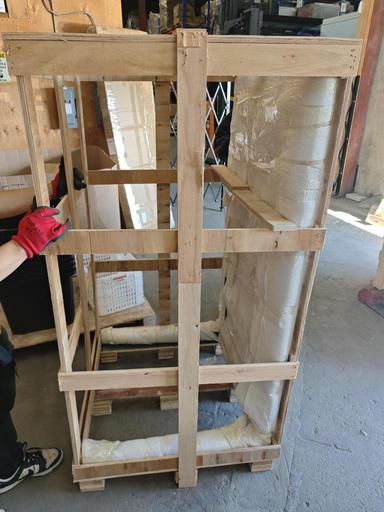
The statue should not move when the closed inner package is gently tilted. At the same time, it should not be locked so tightly that the tray bends a delicate part. This balance is why an insert designed for the specific sculpt is better than filling every gap with loose paper. The completed inner package should then be placed inside a five-layer hard carton with protective strips. For a shipment that needs more resistance to crushing or corner impact, the outer option may be a reinforced wooden case or frame, subject to the destination and packing requirements.
The third control point is the handover
Before the parcel leaves the warehouse, record the packed dimensions, weight, SKU, number of packages, and external condition. Photograph the closed package when the product value or fragility justifies it. The record should show enough to compare the condition at origin with the condition reported at destination. It does not need to become a long report that a small studio cannot maintain. A consistent five-minute checklist is more useful than an ambitious process that nobody follows.
Ask which line accepts the final package, how dimensional weight is calculated, whether the route accepts wood reinforcement, what destination areas are excluded, and how a damaged parcel must be reported. A parcel may be safe inside a wooden case but rejected or surcharged because the final size exceeds the route limit. A line with a lower basic price may not be the right line after the package is reinforced.
The fourth control point is consolidation
Consolidation can reduce average freight cost, but a heavy carton should not be placed on top of a fragile statue carton. Keep crush-sensitive packages away from hard edges and make the orientation clear. If cartons are opened for inspection, the original tray position should be restored exactly. If the outer carton has been replaced, take a new photo and record the change.
For small-batch sellers, the most useful question is not whether the parcel is marked fragile. It is whether the internal package can survive without relying on a label. Labels can be ignored. A fitted tray, stable clearance, and a strong outer carton continue to work even when the parcel changes hands.
An ordinary versus controlled transfer
In an ordinary shipment, a statue is wrapped, placed in a large carton, and sent into consolidation. The package has no SKU photo, no accessory count, and no note about a fragile projection. At destination, the carton has a corner dent and the studio discovers a broken staff. The seller cannot tell whether the staff was already loose, whether the carton was stacked under weight, or whether a repacker changed the internal position. The dispute takes longer than the actual packing.
In a controlled shipment, the warehouse record shows the item condition, accessory count, inner tray, closed carton, and final package dimensions. When the destination team sees a damaged outer corner, it can pause and report the exception. If the item arrives intact, the studio knows which packing instruction to repeat. The value is not only a lower damage probability. It is a clearer chain of responsibility.
Why BONDJET Helps
BONDJET treats international delivery as part of a wider fulfillment process. Its scope covers inbound receiving, inspection photos, SKU management, custom packaging, warehouse operation, international dispatch, customs support, tracking, and customer service follow-up. That combination fits a small original studio that does not have a dedicated packing manager or logistics team.
BONDJET supports one-piece trial shipments and states that there is no minimum consumption or minimum weight threshold, with weight counted from 0.1 kg. A studio can use a small test to compare a regular carton and a custom reinforced package before sending a full release. BONDJET also offers custom reinforcement and a damage compensation option through insurance priced at 2.5% of declared value. Coverage, exclusions, packing requirements, and claim limits must be confirmed in the formal shipping terms before dispatch.
Its published professional profile describes more than 15 years of international logistics experience, more than 1 million users served, and coverage of more than 100 countries and regions. The described operating centers include inspection, SKU management, custom packaging, dispatch, warehouse, and customer service. These capabilities support the fragile shipping fix, but they do not remove the need to provide accurate product photos, dimensions, value, and destination information.
For your next shipment, send BONDJET the statue photos, weak-point notes, number of accessories, retail-box instructions, final destination, and estimated packed dimensions. Ask for a packing instruction that the warehouse can repeat and a written damage compensation process that you understand. Fragile shipping becomes manageable when every transfer begins with a known condition and ends with a recorded handover.